Commercial Waste Bermondsey: Recycling and Sustainability for an Eco-Friendly Waste Disposal Area
 Commercial Waste Bermondsey is committed to creating an eco-friendly waste disposal area that supports local businesses, reduces landfill and accelerates the transition to a sustainable rubbish area across Bermondsey and the wider Southwark borough. Our approach blends practical on-the-ground services with strategic partnerships so that every tonne collected from shops, offices and hospitality sites contributes to reuse, recycling and low-carbon recovery. The aim is clear: make commercial waste management a catalyst for local circular economy activity.
We have set a bold recycling percentage target for our commercial waste services: 65% diversion from landfill by 2030, with an interim target of 50% by 2026. These targets reflect the urgency of reducing embodied carbon in materials and align with broader London ambitions for resource efficiency. To reach this, we combine segregation at source, improved containerisation in communal waste yards, and investment in infrastructure for an effective sustainable rubbish area that serves the needs of local enterprises.
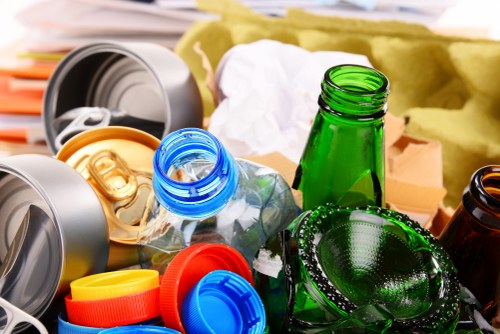 The boroughs’ approach to waste separation is central to our plan: many local businesses already separate food waste, paper and cardboard, glass, metal and mixed dry recycling at source. We support this with clear signage, tailored bin configurations and targeted collections to reduce cross-contamination. Key separation activities include:
- Dedicated food-waste collections and on-site pre-treatment partnerships where viable
- Segregated cardboard and paper streams to protect fibre quality
- Glass and metal collection routes optimised to preserve material value
Local Transfer Stations and Material Processing
We operate with a network of licensed local transfer stations and regional handling hubs to keep the supply chain efficient and low-emission. By transferring segregated streams through nearby depots and transfer stations in Southwark and neighbouring borough handling facilities, we reduce vehicle miles and improve load factors for onward transport to recycling processors. This distributed model supports a resilient eco-friendly waste disposal area and helps maintain material quality through shorter handling chains. We actively cultivate partnerships with charities and social enterprises to prioritise reuse and repair before recycling. Commercial items such as surplus catering equipment, gently used furniture and textiles are redirected to local reuse partners, community projects and charities. Our collaborations include support for local reuse networks, clothing redistribution schemes and asset recovery programmes that keep valuable items in use. These relationships not only reduce waste tonnage but also deliver social value and employment opportunities within Bermondsey.
To reinforce the sustainable rubbish area concept we deliver routine waste audits, route optimisation and material rescue initiatives. Typical measures include:
- Scheduled material recovery days where dry recyclables are consolidated for higher-value processing
- On-site segregation trials to increase capture rates of glass and cardboard
- Targeted engagement with multi-occupancy commercial yards to create shared recycling infrastructure
Low-Carbon Vans and Fleet Decarbonisation
Our service fleet includes low-carbon vans and a growing number of electric vehicles, designed for the stop-start patterns of inner-city collections. Using EVs and hybrid light-commercial vehicles reduces local emissions and noise, making rounds through Bermondsey’s narrow streets more sustainable. We pair this with smart scheduling and load-optimisation software so each trip collects the maximum recyclable yield with the minimum emissions footprint. Monitoring and transparent reporting are part of how we deliver accountability for our recycling percentage target. We publish quarterly diversion metrics and break down performance by stream (organics, paper/cardboard, glass, metal, textiles and residual). These reports support continuous improvement and inform where further investment in communal containerisation or transfer station capacity is needed to hit the 65% by 2030 goal.
 In practice, a thriving sustainable rubbish area in Bermondsey depends on cooperation: businesses separating at source, transfer stations processing clean streams, charities capturing reusable items and a low-carbon vehicle fleet closing the loop. We work closely with local authorities, borough recycling programmes and community partners to align commercial waste collection with wider environmental objectives. Together, we can reduce landfill, lower carbon emissions and reclaim value from the waste that currently leaves our streets.
